About the Laboratory
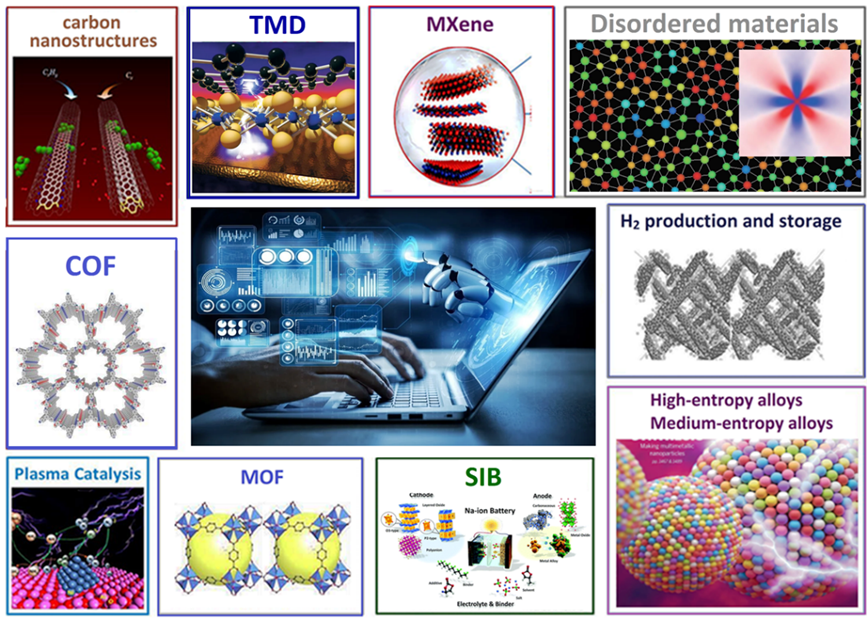
- Mission and strategic objectives: The laboratory was established to create and improve prototypes of advanced materials aimed at addressing pressing challenges related to climate change, the energy crisis, and the environment. This process is carried out through the integrated use of in silico modeling and artificial intelligence methods.
The main mission of the laboratory is to contribute meaningfully to the advancement of global science by designing next-generation materials for green and renewable energy, as well as for modern high-technology sectors, on the basis of innovative approaches.
Within the framework of its strategic objectives, particular attention is given to the identification of promising materials with high performance, economic viability, and strong application potential, as well as to the in-depth study of their properties.
- Metodology: The laboratory has accumulated substantial experience in the use of classical and reactive molecular dynamics (MD) methods for studying material properties. At present, these approaches are being expanded through the integration of quantum-mechanical calculations based on density functional theory (DFT), as well as artificial intelligence tools, including ML and DL methods.
Research Areas
- Computational design and modeling of nanomaterials
- Materials for green energy and energy storage systems
- Multiscale modeling of complex and disordered structures
- Application of artificial intelligence methods in materials science
Facilities
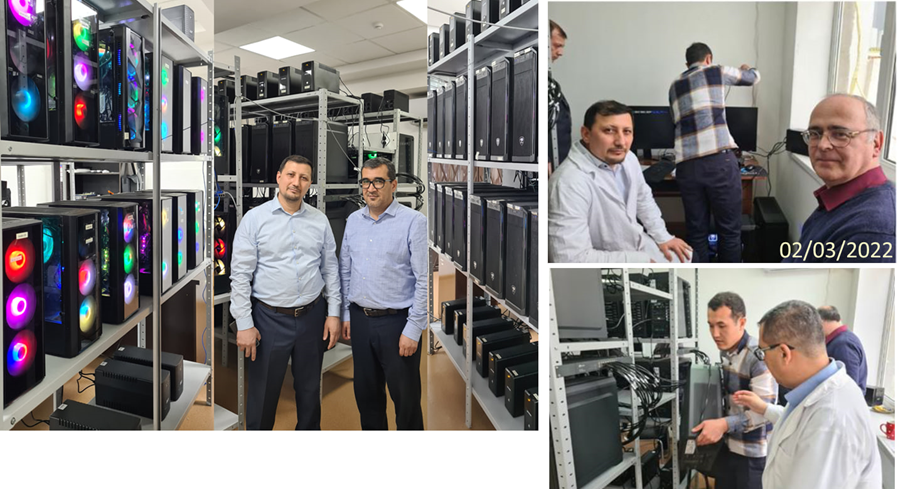
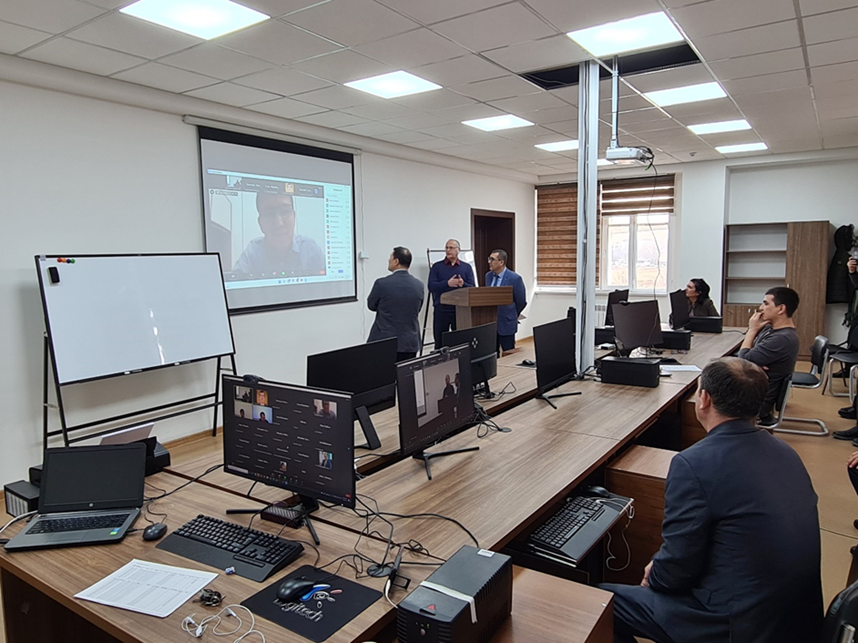
The laboratory is equipped with a high-performance computing (HPC) cluster consisting of 79 computing nodes for carrying out computational experiments. The HPC cluster was established within the framework of the fundamental project F-FA-2021-512, funded by the Agency for Innovative Development for the period 2021-2026. The cluster integrates a master node and compute nodes connected through a dedicated internal 1 GbE network.
Total computing capacity:
- 1264 CPU cores (Intel x86-64, 8-16 cores per node with hyper-threading)
- Approximately 2528 GB of RAM (32-64 GB DDR4 per node)
- 14 NVIDIA GPUs (GTX 1050 Ti, CUDA Compute Capability 6.1, sm_61) for GPU-enabled packages
Resource management — SLURM. The cluster is managed through the industry-standard SLURM Workload Manager. Users submit jobs to the queue, and the system automatically allocates resources:
- Multiple users can work in parallel
- CPU, GPU, and memory resources are allocated efficiently
Veb portal — Open OnDemand
The cluster can also be accessed remotely through a web browser via (https://hpc.istiqbol-luck.uz), enabling users to:
- Upload and download files
- Submit and monitor jobs
- Use a shell terminal directly in the browser
- Launch interactive applications such as Jupyter and RStudio
Monitoring. The real-time load and activity of the cluster can be monitored at https://hpc.istiqbol-luck.uz/monitoring via Grafana. CPU, RAM, network, GPU usage, and SLURM queue status are available there.
The following modern computational packages are pre-installed and available on all nodes of the cluster:
Quantum-mechanical (DFT/ab initio) packages
- Quantum ESPRESSO 7.3 — plane-wave DFT, MD, phonons (pw.x, ph.x, etc.)
- CASTEP 23.1 — DFT, NMR, spectroscopy (MPI parallel)
- DFTB+ 25.1 — approximate DFT for faster calculations on large systems
- ORCA 6.1.1 — quantum chemistry (DFT, post-HF, TDDFT, CASSCF)
Molecular dynamics (MD)
- LAMMPS — classical MD, reactive ReaxFF MD, GPU+CPU (Kokkos backend, CUDA sm_61)
- GROMACS 2024.4 — biomolecular MD, GPU-accelerated, MPI+OpenMP
- GPUMD 5.3 — GPU-based MD supporting NEP (Neuroevolution Potential) machine-learning potentials
Enhanced sampling / metadynamics
- PLUMED 2.9.3 — metadynamics, free-energy calculations, integrated with GPUMD
Python / ML ecosystem
- Python 3.x, NumPy, SciPy, Matplotlib
- Machine-learning libraries (PyTorch, TensorFlow, scikit-learn in user environments)
- Materials-science libraries such as ASE (Atomic Simulation Environment) and Pymatgen
- Jupyter Notebook/Lab through the web portal
Compilers and libraries
- GCC, gfortran, OpenMPI, FFTW, BLAS/LAPACK, OpenBLAS, ScaLAPACK
- CUDA 12.6, cuDNN for GPU programming
Projects & Publications
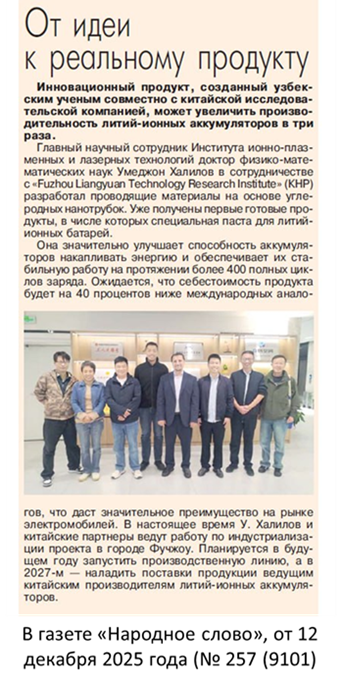
- Current project: Selective synthesis of carbon nanostructures for prospective nanodevices (fundamental project, F-FA-2021-512, 2021-2026).
- Selected publications
- Khalilov, A. Bogaerts, E. C. Neyts, Atomic scale simulation of carbon nanotube nucleation from hydrocarbon precursors. Nat. Commun. 6, 10306 (2015). https://doi.org/10.1038/ncomms10306
- Khalilov, G. Pourtois, A. C. T. van Duin, E. C. Neyts, Toward the Understanding of Selective Si Nano-Oxidation by Atomic Scale Simulations. Accounts of Chemical Research 50, 796-804 (2017). https://doi.org/10.1021/acs.accounts.6b00564
- Khalilov, E. C. Neyts, Mechanisms of selective nanocarbon synthesis inside carbon nanotubes. Carbon 171, 72–78 (2021). https://doi.org/10.1016/j.carbon.2020.08.060
- Uljayev, F. Turaev, A. Ulukmuradov, K. Mekhmonov, U. Khalilov, Can endohedral transition metals enhance hydrogen storage in carbon nanotubes? International Journal of Hydrogen Energy 55, 604–610 (2024). https://doi.org/10.1016/j.ijhydene.2023.11.195
- Khalilov, A. Bogaerts, B. Xu, T. Kato, T. Kaneko, E. C. Neyts, How the alignment of adsorbed ortho H pairs determines the onset of selective carbon nanotube etching. Nanoscale 9, 1653–1661 (2017). https://doi.org/10.1039/C6NR08005G
Collaborations
- International collaborators
- University of Antwerp - PLASMANT & MOSAIC (Belgium)
- Université d'Orléans - GREMI (France)
- Dalian University of Technology - Joint Laboratory for Advanced Plasma Science (China)
- Harbin Institute of Technology (China)
- University of Tehran (Iran)
- Istanbul Technical University (Türkiye)
- Abdus Salam International Centre for Theoretical Physics - ICTP (Italy)
- Kazakh-British Technical University (Kazakhstan)
- Institute for Problems of Superplasticity of Metals (Russia)
- Hebrew University of Jerusalem (Israel)
- Qatar Environment and Energy Research Institute, Hamad Bin Khalifa University (Qatar)
- Institute of General and Inorganic Chemistry (Academy of Sciences of Uzbekistan)
- Institute of Materials Science (Academy of Sciences of Uzbekistan)
- National University of Uzbekistan
- TIIAME National Research University
- Tashkent State Technical University
- Samarkand State University
- Scientific laboratory under the Denov Institute of Entrepreneurship and Pedagogy, Samarkand State University
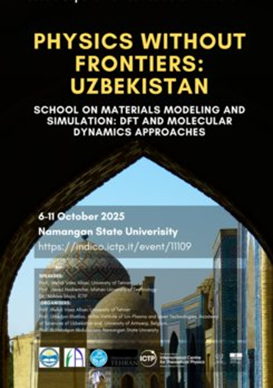
- Namangan State University
- Termez State University
- Bukhara State University
- Namangan Institute of Engineering and Construction
- Tashkent Institute of Textile and Light Industry
- Tashkent University of Information Technologies
- Fergana Polytechnic Institute
- Karshi State University