• +998 71 262 31 69
  • info@iplt.uz

Laboratory of Adsorption and Emission Phenomena

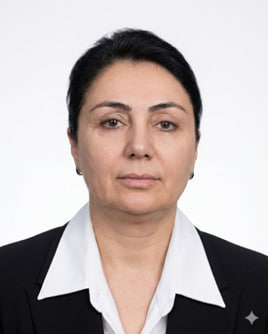
Head of the Laboratory:
Saidа S. Iskhakova
Doctor of Physical and Mathematical Sciences (DSc), Senior Researcher
E-mail: saidais@mail.ru


  1. About the Laboratory
  • Mission and Strategic Goals:

Transition to the application of new innovative methods in the study of the interaction of polyatomic active organic substances with solid surfaces under vacuum and atmospheric conditions at different energy levels, and bringing the obtained results to the level of global research achievements. Development of methods and technologies for studying solid-state electronics and spectroscopy in applied fields.

Research focuses on the application of innovative methods for polyatomic active organic substances — narcotic, psychotropic, and toxic molecules — and the creation of new types of ion sources. Development of methods for sputtering secondary ion emission from nanolayers and nanomaterials using cluster ions of metallic, organic, and inorganic substances. Investigation of the mechanisms of formation, as well as electronic and crystalline properties, of multilayer and multicomponent nanostructures formed as a result of ion implantation and sputtering of various metals in semiconductors, dielectrics, and free metal films.


  • Why this laboratory was established (Problems and Solutions):


The laboratory was established in 1982 by Academician U. Kh. Rasulev (1939–2021). The ongoing fundamental research is devoted to problems of the interaction of polyatomic particles with solid surfaces in the field of physical electronics at thermal and keV (up to 20 keV) energies. These studies cover adsorption and condensation of complex polyatomic molecules, sputtering of solids, including bombardment by polyatomic cluster ions.

As a result of research conducted by laboratory staff, the field of dissociative surface ionization (DSI) of organic and bioorganic molecules has significantly developed, and a new research direction has emerged — from the development of methods for determining the properties of polyatomic molecules and their interaction characteristics with surfaces to new directions in mass spectrometry and gas-analytical instrumentation.

The use of this new ionization method has led to the creation of highly selective and highly sensitive analytical methods and devices that have no analogues worldwide. These include diode systems, gas chromatography detectors, drift spectrometers, ion mobility spectrometers, mass spectrometers, and indicators for detecting narcotic and psychotropic substances.

Fundamental and applied aspects of the interaction of “energetic” (accelerated) polyatomic ions with solid surfaces during molecular bombardment have been established. The manifestation of nonlinear cascades or high-density cascades — “thermal spikes” — has been observed, and mechanisms of cluster emission in ion sputtering of solids have been explained. These studies on the interaction of polyatomic particles with solid surfaces have been widely recognized by the international scientific community.

In addition, energy losses of ions and electrons during transmission and reflection through thin films of metals and crystals have been studied depending on the orientation of different crystal modifications. Quantitative elemental and chemical composition analysis of materials has been carried out using Auger electron and mass spectrometry methods. Methods for obtaining thin free metal films and layered structures have been developed, and their electrophysical properties have been investigated. Mechanisms of nanostructure formation and size-effect phenomena in nanomaterials are currently being studied.

  1. Research Areas
  • Interaction of polyatomic particles of organic and bioorganic compounds with solid surfaces at thermal velocities — adsorption processes and heterogeneous reactions, particle desorption including ion thermodesorption;
  • Development of new surface ionization methods and gas-analytical instruments for highly sensitive trace analysis of physiologically active organic compounds in various media — narcotic drugs, psychotropic substances, and various toxic compounds;
  • Nonlinear non-additive effects in the bombardment of metals, semiconductors, and organometallic films by cluster ions;
  • Improvement of the secondary ion mass spectrometry method using cluster sputtering components and development of new surface diagnostic methods for nanotechnology applications;
  • Mechanisms of nanostructure formation and laws of size effects in nanomaterials.
  1. Infrastructure and Resources (Facilities)

In the “Adsorption and Emission Phenomena” laboratory, a unique thermodesorption surface ionization spectrometer (Iskovich), with no analogues in the world, has been developed for the analysis of physiologically active organic substances. This compact device enables highly sensitive analysis (from 10⁻¹⁰ g) of physiologically active organic substances in biological extracts and forensic materials, as well as environmental toxins. Detection limit for narcotic substances: from 0.5 ng/L; analysis time: 3 minutes; equipped with “Druggy-1” software; stationary desktop version; power consumption:
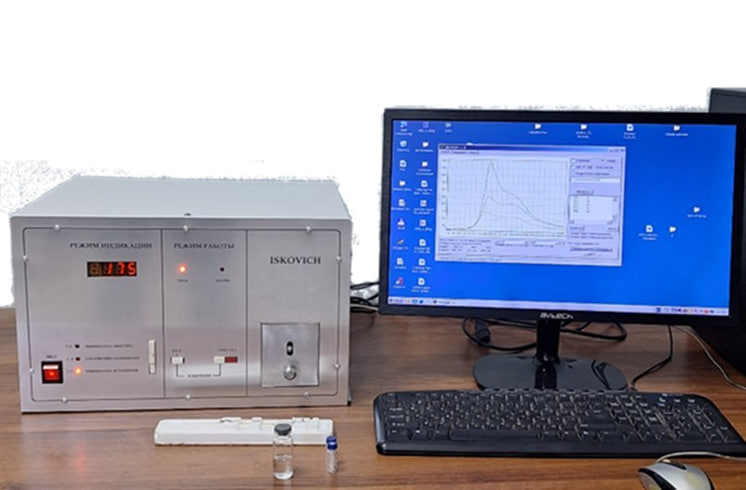
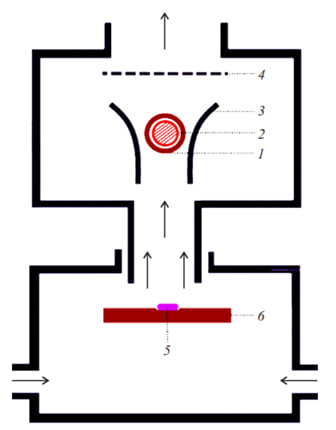
General view and working principle of the “Iskovich” spectrometer

In the study of surface ionization processes of organic compounds, a modernized static magnetic mass spectrometer MI-1201B (“Elektron”, Sumy, Ukraine) is used. To introduce the ion flux generated by the surface ionization method into the mass spectrometer analyzer, a unified ion-optical system is employed. The ion accelerating potential is Vt.p = 2.5–5 keV, and the mass range is 1–900 a.m.u. The working vacuum is maintained at (1–3)·10⁻⁶ Pa. In the magnetic field of the mass analyzer, the ion beam forms a sector shape with a deflection angle of 127°.

Recording of mass spectra is carried out by linear variation of the magnetic field at a constant accelerating potential.
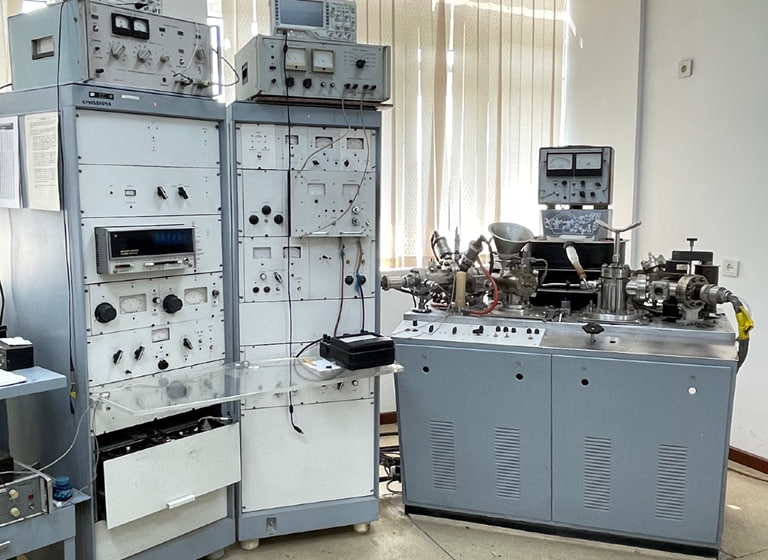
General view of the MI-1201B mass spectrometer

This device is a high-voltage field surface ionization mass spectrometer modernized on the basis of MI-1201B. It is designed to study surface ionization processes of organic and other substances in strong electric fields. The system consists of a high-vacuum ionization chamber, a coaxial cylindrical ion-optical system, a field surface ionization emitter, a multi-channel substance introduction system, ion focusing and extraction lenses, and a mass analyzer.

The device uses a tungsten-based emitter with a diameter of 50 μm, around which a strong electric field of 10⁵–10⁶ V/cm is generated. As a result, surface ionization, thermal desorption, and ion formation processes of molecules and atoms are observed with high precision.
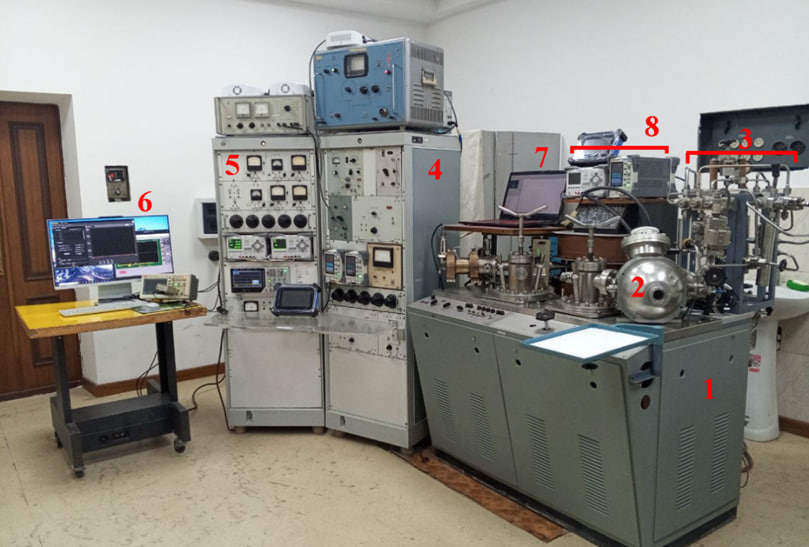
General view of the MI-1201Б mass spectrometer

A device for studying nonlinear and non-additive effects in the bombardment of metals, semiconductors, and metal-organic films by cluster ions. In this setup, the interaction of accelerated polyatomic, multiply charged, and cluster ions with a solid body is studied. Secondary emission processes are also investigated, including sputtering, secondary ion, electron, and photon emission.

In addition, nonlinear non-additive increase effects in sputtering of solids in the form of impurity-containing clusters and molecules are studied in a comprehensive manner. These effects significantly increase the sensitivity of the secondary ion mass spectrometry (VIMS/SIMS) method.
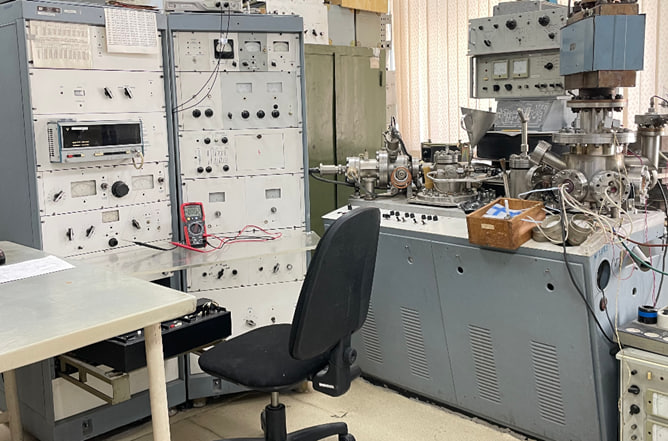
General view of the MI-1201T mass spectrometer

The small-angle spectrometer is a universal device in which the following methods can be used: Auger electron spectroscopy (OES), electron characteristic energy loss spectroscopy (EXEYS), elastic and inelastic reflected electron spectroscopy (EQES, NQES), as well as spectroscopy of electrons and ions transmitted and reflected from thin films.

Using these methods, the crystal and electronic structure, energy loss dispersion, composition, and properties of various materials are studied.
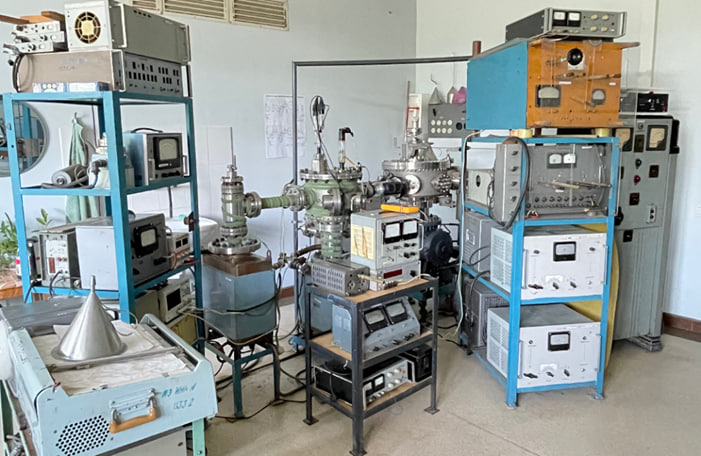
This universal device operates under ultra-high vacuum conditions of approximately ~5×10⁻⁹ Pa.


  1. Projects & Publications

Current Projects

  1. F3-20200930459 “Mechanisms of formation of multicomponent nanostructures on the surface of inorganic (Ti, W, WOx, TiO₂, Si, SiO₂) and organic (polymers) materials upon implantation with metal ions and adsorption of molecules of active organic compounds.” Execution period: 11.2021–11.2026
  2. FL-5421101794 “Regularities of selectivity of thermal ionization of organic molecules under the influence of a strong electric field.” Execution period: 05.2024–05.2029


Selected Publications


  1. Akhunov, Sh., Ashurov, K., Axmedov, Sh., Radjabov, A., Usmanov, D. Development of surface ionization mass-spectrometry for detection of stimulants in human urine. European Journal of Mass Spectrometry, 2021, 27(1), pp. 29–38. https://doi.org/10.1177/14690667211002777
  2. Akhunov, Sh.D., Rasulev, U.K., Usmanov, D.T. On the Sputtering of Copper Phthalocyanine Molecules on a GaAs Substrate under Bombardment with Multiply Charged Ions. Journal of Surface Investigation, 2021, 15(2), pp. 396–400. https://doi.org/10.1134/S1027451021020208
  3. A. Isakhanov, R.M. Yorkulov, B.E. Umizakov, M.Sh. Isayev, and A.A. Abduvaitov. Electronic structure and properties of nanoscale structures created on the surface of a free Si/Cu film system. Journal of Surface Investigation: X-ray, Synchrotron and Neutron Techniques, 2021, Vol. 15, No. 2, pp. 401–403. https://doi.org/10.1134/S106378422201011X
  4. E. Umizakov, Z.A. Isakhanov, R.M. Yorkulov, G.Kh. Allaerova. The Effect of Stepwise Postimplantation Annealing on the Composition and Structure of Silicon Surface Layers Implanted with Alkali Metal Ion. Technical Physics Letters, 2021, Vol. 47, p. 11. https://doi.org/10.1134/S1063785021010120
  5. Sh. Radjabov, S.S. Iskhakova, D.T. Usmanov. Investigation of the Operation Speed of Surface-Ionization Detectors. Technical Physics, 2022. https://doi.org/10.1134/S106378422201011X
  6. Radjabov A.S., Iskhakova S.S., Usmanov D.T. Investigation of the Operation Speed of Surface-Ionization Detectors. Technical Physics, 2022, Vol. 67, No. 2, pp. 104–111. https://doi.org/10.21883/JTF.2021.12.51753.164-21
  7. Sh. Radjabov, U. Khasanov, S.S. Iskhakova, Sh.M. Akhmedov, G.P. Kakhramonova, Sh.Dj. Akhunov, D.T. Usmanov. Analytical capabilities of a thermodesorption spectrometer with a surface-ionization detection of organic molecules in air. Technical Physics, 2023, Vol. 68, No. 3, pp. 389–395. https://doi.org/10.21883/TP.2023.03.55815.203-22
  8. Akhunov, S.D., Kakhramonova, G.P., Usmanov, D.T. Ion-photon emission under bombardment of Ta target with cluster and multiply charged Bi ions. Vacuum, 2023, 213, 112160. https://doi.org/10.1016/j.vacuum.2023.112160
  9. E. Umirzakov, A.A. Abduvayitov, Z.A. Isakhanov, J.Sh. Sodikjanov. Morphology, Composition, and Electronic Structure of the Surface of Thin CdS Films Grown on a Mo(III) Surface. Journal of Surface Investigation: X-ray, Synchrotron and Neutron Techniques, 2023, Vol. 17, No. 6, pp. 1278–1281. https://doi.org/10.1134/S1027451023060216
  10. A. Isakhanov, B.E. Umirzakov, D.Kh. Nabiev, G.T. Imanova, I.R. Bekpulatov, F.Ya. Khudaykulov, S.S. Iskhakova, Kh.E. Abdiyev. Influence of O2+ ions on the composition and electronic structure of the W(111) surface. Micro and Nano Systems Letters, 2024, 12:25. https://doi.org/10.1186/s40486-024-00215-z
  11. E. Umirzakov, J.Sh. Sodikjanov, Z.A. Isakhanov, A.A. Abduvayitov. Effect of the Implantation O2+ Ions on the Composition and Electronic Structure of CdS Films. Journal of Surface Investigation: X-ray, Synchrotron and Neutron Techniques, 2024, Vol. 18, No. 3, pp. 594–597. https://doi.org/10.1134/S1063784215120130
  12. A. Isakhanov, B.E. Umirzakov, G.T. Imanova. Theoretical and experimental study of plasmon oscillation dispersion in Si and Ge crystals. Optical Materials: X, Vol. 24, 2024, 100354, pp. 1–4. https://doi.org/10.1016/j.omx.2024.100354
  13. Saydumarov, D. Usmanov. Studies of the Organic Molecules Dissociative Surface Ionization in the Mass-Spectrometric Surface Ionization Method. Mass Spectrometry Letters, 2024, Vol. 15, No. 1, pp. 54–62. https://doi.org/10.5478/MSL.2024.15.1.54
  14. Kakhramonova, Sh.Dj. Akhunov, M.M. Nazarov, R.R. Mavlonov, D.T. Usmanov. Secondary Ion Emissions of Tm and Tb Targets Under Bombardment With Cluster Ions. Surface and Interface Analysis, 2025, Vol. 57, Issue 1, pp. 36–41. http://doi.org/10.1002/sia
  15. Hiraoka, K., Rankin‐Turner, S., Usmanov, D.T., Akhmedov, S.M., Ninomiya, S. How do cocaine and morphine in methanol solution desorb at the last moment of Leidenfrost phenomenon-assisted thermal desorption? Rapid Communications in Mass Spectrometry, 2025, Vol. 39, No. 1, e9933. https://doi.org/10.1002/rcm.9933
  16. Hiraoka, K., Rankin-Turner, S., Usmanov, D.T., Akhmedov, S.M., Ninomiya, S. Leidenfrost phenomenon-assisted thermal desorption (LPTD) using a metal substrate coated with a fluoro compound: Mechanism of analyte evaporation. International Journal of Mass Spectrometry, 2025, Vol. 512, 117434. https://doi.org/10.1016/j.ijms.2025.117434
  17. Hiraoka, K., Rankin-Turner, S., Usmanov, D.T., Ninomiya, S. Atmospheric pressure surface ionization mass spectrometry for oxidized SUS304 and nichrome: chromic acids as intermediate precursors for the formation of hexavalent chromium oxide negative ions. International Journal of Mass Spectrometry, 2025, 117506. https://doi.org/10.1016/j.ijms.2025.117506
  18. Khasanov, S.S. Iskhakova, A.Sh. Radjabov, Sh.M. Akhmedov, Sh.T. Toirov, A.S. Kholmatov, B.Sh. Kasimov, Yu Zhan, D.T. Usmanov. Mass Spectrometric Study of Heterogeneous Reactions of Transformations of Molecules of Butyrophenone Derivatives During Adsorption on a Hot Surface of Tungsten Oxide. Journal of Mass Spectrometry, 2025, Vol. 60, No. 12, e5193. https://doi.org/10.1002/jms.5193
  19. Akhmedov, A. Radjabov, B. Kasimov, I. Saydumarov, U. Khasanov, Sh. Akhunov, D. Usmanov. Surface Ionization Mass Spectrometry of Imidacloprid and Chlordimeform on Oxidized and Metallic Tungsten Surfaces. Mass Spectrometry Letters, 2025, Vol. 16, No. 1, pp. 13–21. https://doi.org/10.5478/MSL.2025.16.1.13
  20. Hiraoka, D.T. Usmanov, Sh.M. Akhmedov, S. Rankin-Turner, S. Ninomiya. Surface Ionization of Carbaryl, Papaverine, Cocaine, Morphine, and Triethylamine by Heated Surface-Oxidized Metal Filaments. Rapid Communications in Mass Spectrometry, 2025, 39:e10029. https://doi.org/10.1002/rcm.10029
  21. Akhunov, S. D., Saydumarov, I. M., Urolov, S. Z., Iskhakova, S. S., Akhmedov, S. M., Radjabov, A. S., Zhan Yu, Usmanov, D. T.. Secondary ion emission of a surface quartz resonator coated with silver under bombardment by multiply charged Cs+ and Si+ ions //Vacuum. – 2026. – С. 115428. https://doi.org/10.1016/j.vacuum.2026.115428
  22. Liu, L., Wang, L., Liu, C., Zhang, Y., Usmanov, D. T., Han, Z., & Yu, Z. Direct Z-scheme charge transfer in a Bi4O5Br2/Sn-based mental-organic framework composite enabling efficient visible-light removal of oxytetracycline. Journal of Colloid and Interface Science, Volume708, 15 April, 139860. https://doi.org/10.1016/j.jcis.2026.139860
  23. Hiraoka, K., Rankin-Turner, S., Usmanov, D. T., & Ninomiya, S. Thermal desorption of preformed polyoxometalate anions on the heated oxidized Re, W, and Mo under ambient atmospheric pressure studied by mass spectrometry. International Journal of Mass Spectrometry, Volume 519, https://doi.org/10.1016/j.ijms.2026.
  24. E. Umirzakov, Z.A.Isaxanov, I.R.Bekpulatov, I.O.Kosimov, M.M. Maxmudov, Gunel Imanova, Study of the influence of temperature and gamma radiation on the crystal structure of a thin TiO2 coating obtained on A Si(111) surface / Physics Letters A 580 (2026) 131519 / DOI: ttps://doi.org/10.1016/j.physleta.2026.131519.


  1. Collaborations
  • Foreign Universities

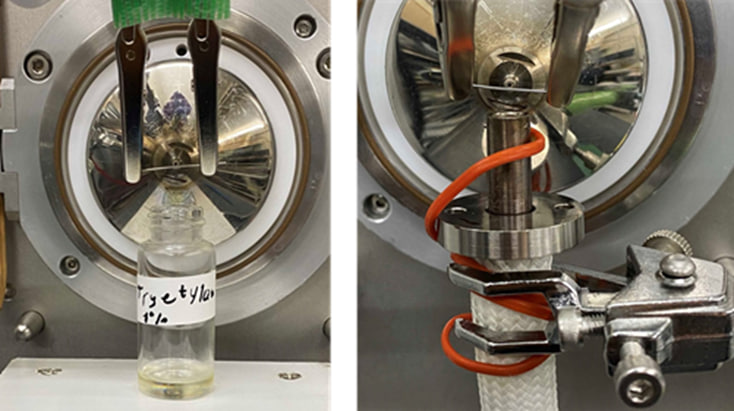
Our laboratory carries out scientific cooperation with the Clean Energy Research Center at the University of Yamanashi (Japan). Within the framework of this collaboration, studies are being conducted on the factors influencing the selectivity of surface ionization of organic compound molecules in mass spectrometers operating under atmospheric conditions. In addition, processes related to the application of new evaporation methods are being investigated in order to ensure a constant flux of substance molecules to the emitter surface during the surface ionization process.
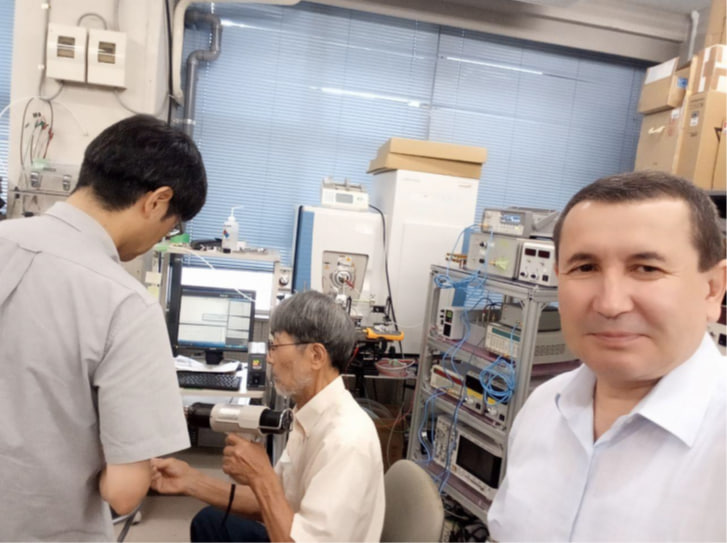
  • National Integration

Our laboratory has established scientific and research cooperation with leading higher education and scientific institutions of the Republic of Uzbekistan and conducts joint research in the fields of modern physics, materials science, vacuum technologies, mass spectrometry, and surface phenomena.

In particular, our laboratory actively collaborates with the following higher education institutions:

  • National University of Uzbekistan named after Mirzo Ulugbek;
  • Tashkent State Technical University named after Islam Karimov;
  • Tashkent State Transport University;
  • Urgench State University named after Abu Rayhan Beruni.

Within the framework of this cooperation, joint scientific projects are carried out with the participation of professors and teaching staff as well as young researchers, along with experience exchange, scientific seminars, and applied research activities. In addition, the scientists of our laboratory provide scientific supervision for bachelor’s and master’s students of these universities, closely assisting them in the preparation of their graduation theses and master’s dissertations.

In our laboratory, a necessary scientific environment has been created for students to work with modern scientific equipment, conduct experimental research, and develop skills in preparing scientific publications. This contributes to increasing the scientific potential of young specialists, strengthening the integration of science and education, and training highly qualified personnel.

6. Events & Webinars / Workshops

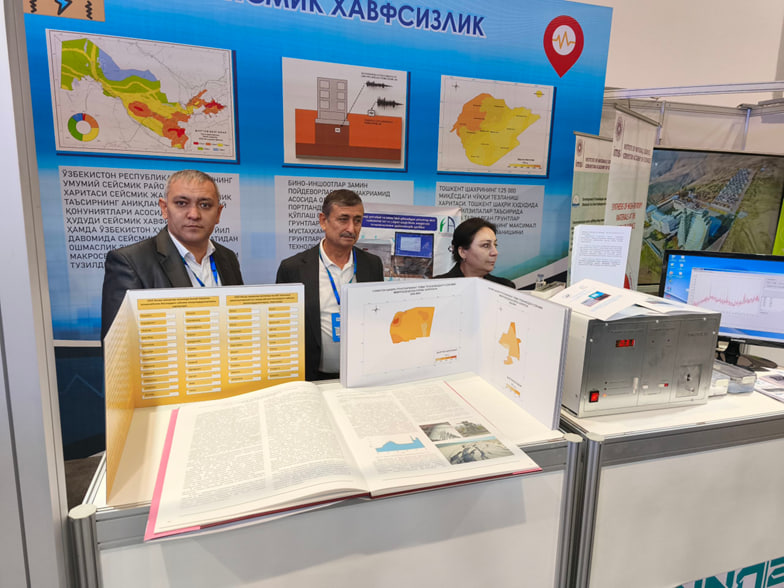
From 9 to 11 October 2025, one of the largest innovation events in our country — the International Innovation Ideas Week “Innoweek.uz–2025” — will be held. This international platform is organized with the aim of accelerating innovative development in the republic, widely implementing modern innovations and advanced technologies across all sectors of the economy, as well as developing science, education, and human capital.

Within the framework of “Innoweek.uz”, local and foreign scientists, innovators, startup project developers, industrial enterprises, and research centers present their developments and technological achievements.

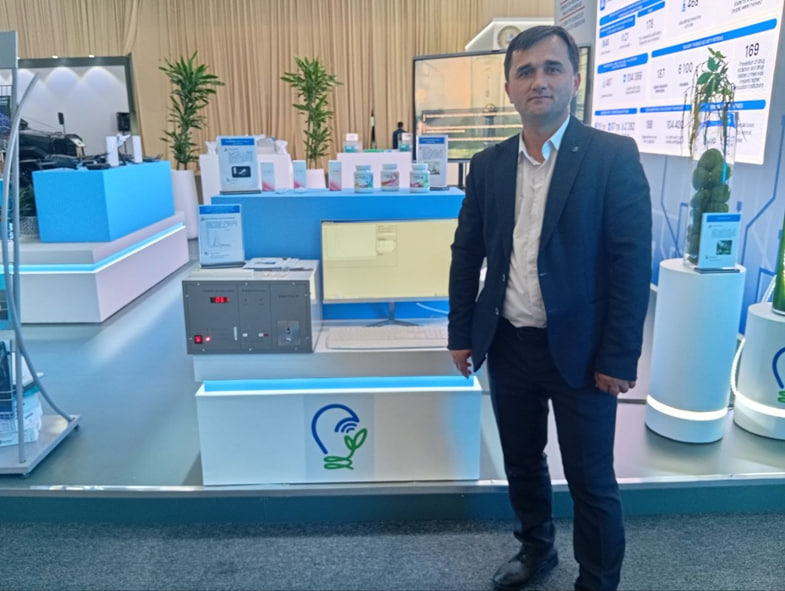
In this prestigious event, the staff of our laboratory also actively participate and present the “Iskovich device” among their scientific and technological developments. This device is one of the modern experimental systems used in scientific research and enables high-precision study of physical and chemical processes.

During the event, the laboratory specialists present the working principle of the device, its scientific and practical significance, as well as its prospects for use in scientific research.

The participation of our laboratory in “Innoweek.uz–2025” contributes to the popularization of scientific developments, the advancement of innovative projects, and the strengthening of the integration between science and industry.
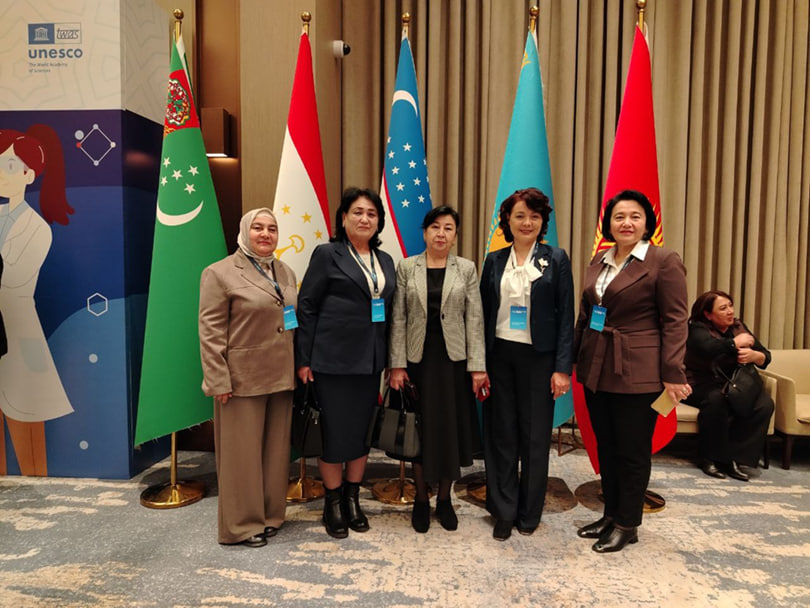
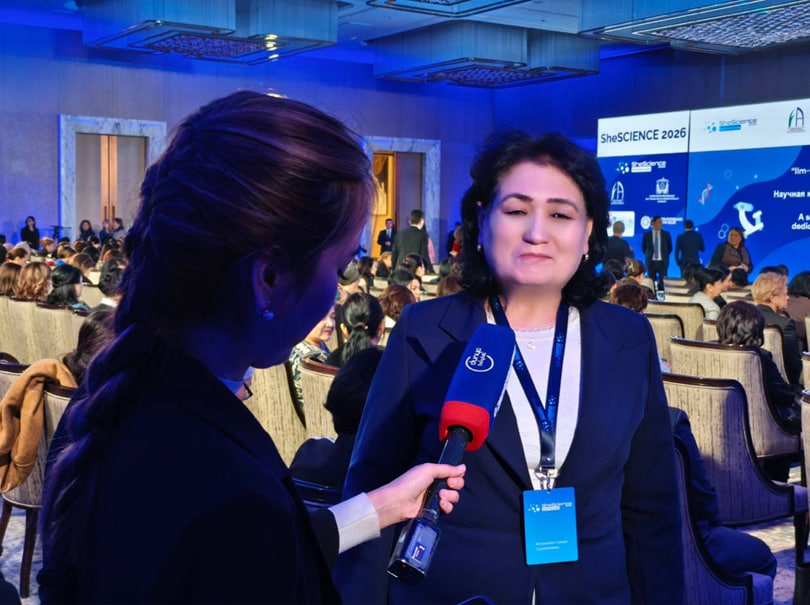
On February 11, 2026, an event was held at the Hilton Hotel on the occasion of the International Day of Women and Girls in Science. The event was attended by representatives and leaders of The World Academy of Sciences (TWAS), UNESCO, ADB, as well as other international and regional organizations. The SheScience 2026 conference was organized by the Academy of Sciences of Uzbekistan, the Committee on Family and Women Affairs, and the Ministry of Higher Education, Science and Innovation.

The meeting with many leading women scientists and leaders from Central Asian countries was a great honor for us. We believe that their contributions to the development of science and their efforts in inspiring future generations are highly commendable.

The head of our laboratory, DSc (Doctor of Sciences in Physics and Mathematics) Iskhakova Saida Sunnatovna, actively participated in this event and gave interviews to local television channels about the event and its objectives.
In accordance with the instruction of the Head of the Administration of the President of the Republic of Uzbekistan No. 02-PA 1/1-4668 dated December 31, 2025, on April 20–21, 2026, in the city of Samarkand, within the framework of an international forum organized in cooperation with the United Nations Office on Drugs and Crime, participation was made in the exhibition of scientific achievements in the field under the theme “Combating transnational drug threats endangering public health and safety”.
  • Teaching Materials (Tutorials & Training)

Monographs published by the professors and lecturers of our laboratory.
  1. Исхакова С.С., Сайдумаров И.М. Термодесорбционная поверхностно-ионизационная спектрометрия активных органических соединений. Монография. Ташкент: “Shafoat Nur Fayz”, 2021, -152 с.
  2. Исаханов З.А Электронная структура, эмиссионные и оптические свойства нанопленочных систем, созданных на основе металлов и полупроводников // Монография. “Фан ва технологиялар нашриёт-матбаа уйи”. Ташкент-2022
  3. Исхакова С.С. Исследование актуальных классов психотропных средств и каннабиноидов методами поверхностной ионизации. Монография. -Ташкент: СП “PUBLISHING HIGH FUTURE”, - 2025, -185 с

ОСНОВНЫЕ ПУБЛИКАЦИИ

лаборатории адсорбционных и эмиссионных явлений

  1. S.S.Iskhakova, U.Khasanov, U. Kh. Rasulev, D. T. Usmanov. Thermodesorption Spectrometer of Hard-Volatile Active Organic Compounds, Technical Physics Letters, 2020, Vol. 46, No. 12, pp. 1231–1234. ( 2020 Journal Citation Reports; IF=0.787).
  2. U.Khasanov, S.S.Iskhakova, D.T.Usmanov. Examination of the effect of air atmosphere on heterogeneous reactions under surface ionization ofpsychotropic drug molecules. European Journal of Mass Spectrometry P.409-418. (2020 Journal Citation Reports; IF=1.011).
  3. A.Sh. Radjabov, S.S. Iskhakova, D.T. Usmanov, Investigation of the Operation Speed of Surface-Ionization Detectors, Technical Physics, © Pleiades Publishing, Ltd., 2022. DOI: 10.1134/S106378422201011X
  4. A.Sh. Radjabov, D.T. Usmanov, S.S. Iskhakova, Sh.M. Akhmedov, G.P. Kakhramanova, Sh.Dj. Akhunov, U.Khasanov, Analytical capabilities of thermodesorbtion spectrometer’s with surface ionization detection of organic compounds in the air, Journal of Technical physics, 93(3), 2023 (in Russian).
  5. A.Sh. Radjabov, U. Khasanov, S.S. Iskhakova, Sh.M. Akhmedov, G.P. Kakhramanova, Sh.Dj. Akhunov, D.T. Usmanov. Analytical capabilities of a thermodesorption spectrometer with a surface-ionization detection of organic molecules in air. Technical Physics, 2023 (accepted).
  6. G. T. Rakhmanov, B. E. Umirzakov, D. T. Usmanov. Determination of the kinetic characteristics of thermodesorption and the heterogeneous reaction of the dissociation of morpine molecules on the surface of oxidated tungsten. Journal of Surface Investigation: X-ray, Synchrotron and Neutron Techniques, 2023 (accepted).
  7. GT Rakhmanov and DT Usmanov, Mass-spectrometric studies of kinetic characteristics of codeine molecule thermodesorption by non-stationary surface ionization method, Eur J Mass Spectrom 2022;28(5-6):127-131.
  8. Z.A. Isakhanov, T. Kodirov, A.S. Halmatov, M.K. Ruzibaeva, Z.E. Muhtarov, B.E. UmirzakovEffect of Co+-Ion Implantation on the Composition and Properties of Free Si–Cu Nanofilm Structures / J.of Surface Investigation, X-ray, Sinchrotron and Neutron Techniques. Vol.11, No.1, 2017, P.152-155.
  9. B.E. Umirzakova, M. K. Ruzibaevaa, Z. A. Isakhanova,*, and R. M. Erkulova«Formation of Nanodimensional SiO2 Films on the Surface of a Free Si/Cu Film System by Ion Implantation» / ISSN 1063-7842, Technical Physics, 2019, Vol. 64, No. 6, pp. 887–889. © Pleiades Publishing, Ltd., 2019.
  10. R. Djabbarganova, B. G. Atabaeva, Z. A. Isakhanova, and U. B. Sharopova, * “Energy Threshold of the Atomic and Cluster Sputtering of SomeElements under Bombardment with Cs, Rb, and Na Ions” / J. of Surface Investigation: X-ray, Synchrotron and Neutron Techniques, 2019, Vol. 13, No. 4, pp. 640–643. © PleiadesPublishing, Ltd., 2019.
  11. Z.A. Isakhanov,*, I.O. Kosimov, B.E. Umirzakov, and R. M. Erkulov Modification of the Surface Properties of Free Si–Cu Films by Implantation of Active Metal Ions / ISSN 1063-7842, Technical Physics, 2020, Vol. 65, No. 1, pp. 114–117. © PleiadesPublishing, Ltd., 2020.
  12. U.B.Sharopov, B.G.Atabaev, R.Djabbarganov Defect formation on the surface of ZnO using low-energy electrons. Journal of Surface Investigation, X-ray, Synchrotron and Neutron Techniques, 2020, Vol. 14, № 1, р. 101-104. DOI: 10.1134/S1027451020010164
  13. Z.A. Isakhanov, R.M. Yorkulov, B.E. Umizakov, M.Sh. Isayev, and A.A. Abduvaitov. Electronic structure and properties of nanoscaleStuctures Created on the surface of a free Si/Cu film system // Jounal of Investigation: X-ray, Synchrotron and Neutron Techniques, 2021, Vol. 15, No. 2, pp.401-403. DOI: https://doi.org/10.1134/S1027451021020221.
  14. B.E. Umizakov, Z.A. Isakhanov, R.M. Yorkulov, G.Kh. Allaerova. The Effect of Stepwise Postimplantation Annealing on the Composition and Structure of Silicon Surface Layers Implanted with Alkali Metal Ion //Technical Physics Letters,2021, vol. 47, p 11. DOI: https://doi.org/10.1134/S1063785021010120.
  15. Z.A. Isakhanov, B.E. Umirzakov, S.S. Nasriddinov, Z.E. Мuhtarov, R.M. Yorkulov. Study of the critical angle of channeling of active metal ions through thin aluminum films // Technical Physics Letters, 2021,vol. 47, pp .72-76
  16. G. X. Allayarova, D. A. Tashmukhamedova, R. Djabbarganov& B. E. Umirzakov Study of the Processes of the Formation of Nanoscale MoO3 Films by Thermal Oxidation and Ion Bombardment Journal of Surface Investigation: X-ray, Synchrotron and Neutron Techniques volume 15, № 1 pages 81–84 (2021)
  17. B.G. Atabaev, R Djabbarganov, M KhAkhmadjanova, KU Nazarkulova Energy and Temperature Dependence of the Secondary Ion Emission of GaN/SiC Clusters under Cesium-Ion Bombardment Journal of Surface Investigation: X-ray, Synchrotron and Neutron Techniques volume 15, №2 pages 259–262 (2021)
  18. S. A. Boltaeva, Kh. S. Akhmadov, U. R. Gapparov, R. Djabbarganov, M. K. Kurbanov, and D. Sh. Saidov. Thermotechnical and Adsorption Characteristics of the SrCl2 Adsorbent for Ammonia Vapors in Solar Absorption Cycles, //ISSN 0003-701X, Applied Solar Energy, 2022, V ol. 58, No. 1, pp. 116–120
  19. З.А. Исаханов Электронная структура, эмиссионные и оптические свойства нанопленочных систем, созданных на основе металлов и полупроводников // Монография. “Фан ва технологиялар нашриёт-матбаа уйи”. Ташкент-2022
  20. Dilshadbek Tursunbayevich Usmanov, Satoshi Ninomiya, Lee Chuin Chen, SubhrakantiSaha, Mridul Kanti Mandal, Yuji Sakai, Rio Takaishi, Ahsan Habib, Kenzo Hiraoka,Kentaro Yoshimura, Sen Takeda, Hiroshi Wada, and Hiroshi Nonami, Desorption in mass spectrometry (review), Mass spectrometry (Japan), 2017,Vol. 6 (2), S0059.
  21. D.T. Usmanov, K. Hiraoka, H. Wada, M. Matsumura, S. Sanada-Morimura, and H.Nonami, Gaseous ion formation by the cavitation occurred between aqueous solutions and the ultrasonically vibrating blade studied by mass spectrometry, International Journal of Mass spectrometry, 411 (2016) 34–39.
  22. Dilshadbek T. Usmanov, Lee Chuin Chen, Kenzo Hiraoka, Hiroshi Wada, Hiroshi Nonami, and Shinichi Yamabe, Mass spectrometric monitoring of oxidation of aliphatic C6-C8 hydrocarbons and ethanol in low pressure oxygen and air plasmas, Journal of Mass Spectrometry, 2016, 51, 1187–1195.
  23. D. T. Usmanov, K. Hiraoka,Discontinuous atmospheric pressure interface for mass spectrometry using a solenoid pulse valve, Rapid Communications in Mass Spectrometry 2016,30, pp.1870-1874 DOI: 10.1002/rcm.7654.
  24. D. T. Usmanov, K. Hiraoka, H. Wada, S. Morita, H.Nonamiand S. Yamabe, Nitrogen incorporation in saturated aliphatic C6-C8 hydrocarbons and ethanol in low pressure nitrogen plasma generated by a hollow cathode discharge ion source, Journal of Mass spectrometry 51, pp. 446–452, 2016, doi: 10.1002/jms.3765.
  25. D. T. Usmanov, K. Hiraoka, H. Wada, S. Morita, andH.Nonami, Desorption of low-volatility compounds induced by dynamic friction between microdroplets and an ultrasonically vibrating blade, Analyst, 141, pp.1398-1404, 2016.
  26. D. T. Usmanov, Z. Yu, L. C. Chen, K. Hiraokaand S. Yamabe, Low-pressure barrier discharge ion source using air as a carrier gas and its application to the analysis of drugs and explosives, Journal of Mass spectrometry, 51, pp. 132–140, 2016, doi: 10.1002/jms.3732.
  27. D. T. Usmanov, S. Saha, L. C. Chen, S. Ninomiya, M. K. Mandal, and K. Hiraoka, Probe electrospray ionization (PESI) mass spectrometry with discontinuous atmospheric pressure interface (DAPI), European Journal of Mass Spectrometry, 21, 327-334, (2015), doi: 10.1255/ejms.1309.
  28. Md. A. Habib, L. Ch. Chen, D. T. Usmanov, Zhang Yu, and K. Hiraoka, Detection of explosives using a hollow cathode discharge ion source, Rapid Communications in Mass Spectrometry, 29, pp. 601–610, (2015).
  29. D. T. Usmanov, L. C. Chen, Z. Yu, S.Yamabe, S. Sakaki, and K. Hiraoka, Atmospheric pressure chemical ionization (APCI) of explosives using alternating current corona discharge ion source, Journal of Mass spectrometry, Vol.50, issue 4, pp. 651-661
  30. Md. A. Habib, L. Ch. Chen, S. Ninomiya, D. T. Usmanov, and K. Hiraoka, Desorption Mass Spectrometry for Nonvolatile Compounds Using an Ultrasonic Cutter, Journal of American Mass Spectrometry Vol. 25 Iss.7, pp.1177-80, (2014).
  31. Md. A. Habib, D. Usmanov, S.Ninomiya, L. Ch. Chen, and K. Hiraoka, Alternating current corona discharge/atmospheric pressure chemical ionization (APCI) for mass spectrometry, Rapid Communications in Mass Spectrometry, Vol.27, Iss. 24, pp. 2760-2766, (2013).
  32. Dilshadbek Tursunbayevich Usmanov, Satoshi Ninomiya, Lee Chuin Chen, SubhrakantiSaha, Mridul Kanti Mandal, Yuji Sakai, Rio Takaishi, Ahsan Habib, Kenzo Hiraoka,Kentaro Yoshimura, Sen Takeda, Hiroshi Wada, and Hiroshi Nonami, Desorption in mass spectrometry (review), Mass spectrometry (Japan), 2017,Vol. 6 (2), S0059.
  33. D.T. Usmanov, K. Hiraoka, H. Wada, M. Matsumura, S. Sanada-Morimura, and H.Nonami, Gaseous ion formation by the cavitation occurred between aqueous solutions and the ultrasonically vibrating blade studied by mass spectrometry, International Journal of Mass spectrometry, 411 (2016) 34–39.
  34. Dilshadbek T. Usmanov, Lee Chuin Chen, Kenzo Hiraoka, Hiroshi Wada, Hiroshi Nonami, and Shinichi Yamabe, Mass spectrometric monitoring of oxidation of aliphatic C6-C8 hydrocarbons and ethanol in low pressure oxygen and air plasmas, Journal of Mass Spectrometry, 2016, 51, 1187–1195.
  35. D. T. Usmanov, K. Hiraoka,Discontinuous atmospheric pressure interface for mass spectrometry using a solenoid pulse valve, Rapid Communications in Mass Spectrometry 2016,30, pp.1870-1874 DOI: 10.1002/rcm.7654.
  36. D. T. Usmanov, K. Hiraoka, H. Wada, S. Morita, H.Nonamiand S. Yamabe, Nitrogen incorporation in saturated aliphatic C6-C8 hydrocarbons and ethanol in low pressure nitrogen plasma generated by a hollow cathode discharge ion source, Journal of Mass spectrometry 51, pp. 446–452, 2016, doi: 10.1002/jms.3765.
  37. D. T. Usmanov, K. Hiraoka, H. Wada, S. Morita, andH.Nonami, Desorption of low-volatility compounds induced by dynamic friction between microdroplets and an ultrasonically vibrating blade, Analyst, 141, pp.1398-1404, 2016.
  38. D. T. Usmanov, Z. Yu, L. C. Chen, K. Hiraokaand S. Yamabe, Low-pressure barrier discharge ion source using air as a carrier gas and its application to the analysis of drugs and explosives, Journal of Mass spectrometry, 51, pp. 132–140, 2016, doi: 10.1002/jms.3732.
  39. D. T. Usmanov, S. Saha, L. C. Chen, S. Ninomiya, M. K. Mandal, and K. Hiraoka, Probe electrospray ionization (PESI) mass spectrometry with discontinuous atmospheric pressure interface (DAPI), European Journal of Mass Spectrometry, 21, 327-334, (2015), doi: 10.1255/ejms.1309.
  40. Md. A. Habib, L. Ch. Chen, D. T. Usmanov, Zhang Yu, and K. Hiraoka, Detection of explosives using a hollow cathode discharge ion source, Rapid Communications in Mass Spectrometry, 29, pp. 601–610, (2015).
  41. D. T. Usmanov, L. C. Chen, Z. Yu, S.Yamabe, S. Sakaki, and K. Hiraoka, Atmospheric pressure chemical ionization (APCI) of explosives using alternating current corona discharge ion source, Journal of Mass spectrometry, Vol.50, issue 4, pp. 651-661 (selected as featured article and for the front page of the journal, 2015).
  42. Md. A. Habib, L. Ch. Chen, S. Ninomiya, D. T. Usmanov, and K. Hiraoka, Desorption Mass Spectrometry for Nonvolatile Compounds Using an Ultrasonic Cutter, Journal of American Mass Spectrometry Vol. 25 Iss.7, pp.1177-80, (2014).
  43. Md. A. Habib, D. Usmanov, S.Ninomiya, L. Ch. Chen, and K. Hiraoka, Alternating current corona discharge/atmospheric pressure chemical ionization (APCI) for mass spectrometry, Rapid Communications in Mass Spectrometry, Vol.27, Iss. 24, pp. 2760-2766, (2013).
  44. Satoshi Ninomiya, Shunpei Iwamoto, Dilshadbek Usmanov, Shinichi Yamabe, Kenzo Hiraoka, Negative-mode mass spectrometric study on dc corona, ac corona and dielectric barrier discharge ionization in ambient air containing H2O2, 2,4,6-trinitrotuluene (TNT), and 1,3,5-trinitroperhydro-1,3,5-triazine (RDX), Int. J. Mass Spectr., 459 (2021) 116440https://doi.org/10.1016/j.ijms.2020.116440 .
  45. Dilshadbek T. Usmanov, Satoshi Ninomiya, Kenzo Hiraoka, Flash desorption of low-volatility compounds deposited on the heated solid substrate (90оC) by dripping liquid methanol, Rapid Comm. Mass Spectr., Volume 34, Issue 23, 2020, https://doi.org/10.1002/rcm.8949